Marie-Laure LeBlanc and Daniel LeBlanc’s father-daughter relationship
All the Light We Cannot SeeMarie-Laure LeBlanc and Daniel LeBlanc’s father-daughter relationship is made of attentive routines as much as affection: he steadies her after blindness, teaches her to read her surroundings, and gives her a model of their neighborhood she can learn with her hands. When war separates them, the skills and objects he has left behind become both a means of independence and a way of interpreting his absence.
Care After Blindness
When a museum tour ends, Daniel finds Marie-Laure in the Grand Gallery, straightens her glasses, and plucks a leaf from her hair before asking whether she enjoyed herself. The small gestures belong to a closeness that has already begun to shape her daily life. A month after the tour, Marie-Laure is blind; the relationship then enters a more difficult rhythm, without losing its tenderness.
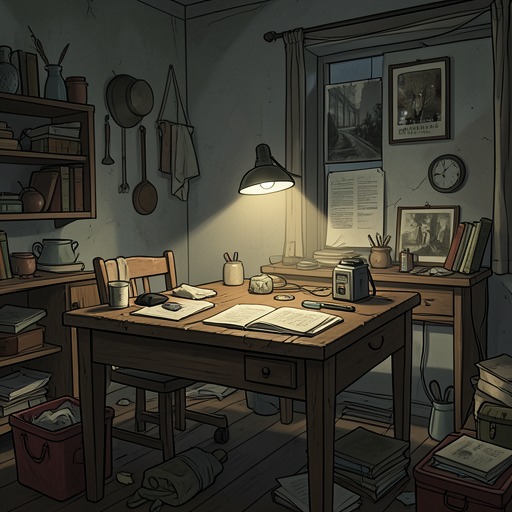
For months, she struggles with rooms that seem to pitch and half-open doors that strike her face. Her bed becomes a sanctuary. Daniel sits beside her, smoking and working on tiny models: the tap of his little hammer and the rasp of sandpaper give the scene a steady, familiar beat amid her disorientation. He does not deny that her days are hard, but he rejects the idea that her blindness is the result of a curse. He tells her that there are no curses, only good or bad luck and each day’s slight inclination toward one or the other.
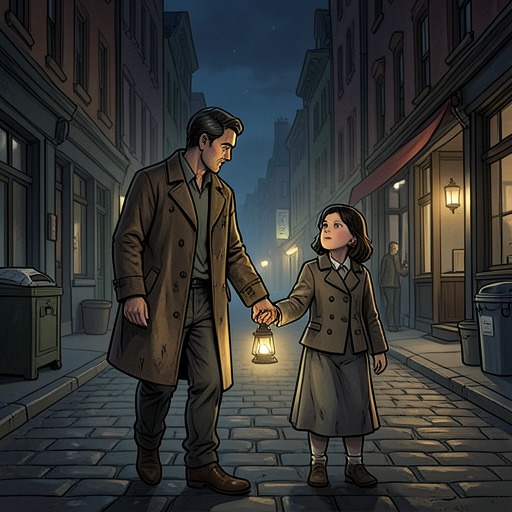
His care is also concrete and repetitive. Six mornings a week, before dawn, he helps her dress, and, when there is time, encourages her to tie her shoes herself. They share strong coffee with as much sugar as she wants. At six forty, she takes her white cane, hooks a finger through the back of his belt, and follows him down three flights and six blocks to the museum. The routine does not erase her dependence on him; it gives their mornings a dependable shape within which she can begin to learn.
Teaching Through Touch and Routine
At the museum, Daniel turns his work as principal locksmith into a daily course for his daughter. He quizzes her about keys and the locations of displays, and places unexpected objects in her hands: a lightbulb, a fossilized fish, a flamingo feather. For an hour each morning, Sundays included, they work through a Braille workbook, starting with dots and moving into simple sentences. In the afternoons, she accompanies him on his rounds as he oils latches, repairs cabinets, and polishes escutcheons. His teaching joins language to objects and places she can explore directly.
At home, he adapts their surroundings with the same care. Marie-Laure crosses six evenly spaced strips on the kitchen tiles to find the table and follows a strand of twine from the table to the toilet. At dinner, Daniel serves food on a round plate and describes its position by the hands of a clock: potatoes at six, mushrooms at three. These arrangements make the home legible through touch, sound, and repeated instruction, rather than asking Marie-Laure to navigate by sight.
The model he builds of their neighborhood extends that work. It includes the tall-windowed houses, rain gutters, nearby shops, and a little place at the end of the street with four benches and ten trees. At night, the real neighborhood and its miniature counterpart mingle in Marie-Laure’s mind. On Tuesdays, she and Daniel sleep in, drink sweet coffee, and sometimes walk beside the Seine or visit a bookshop, where he asks her to estimate a book’s length by running a nail along its pages. Their life together encompasses both deliberate training and ordinary outings; learning does not displace affection or pleasure.
From Guided Lessons to Independent Navigation
Daniel eventually asks Marie-Laure to lead them home using the model she has learned by touch. At first, the exercise repeatedly goes wrong. On successive Tuesdays she takes him on six-block detours, returning frustrated and farther from home than when they began. Daniel continues the practice rather than taking over. During the winter of her eighth year, she begins to recognize the correspondences between model and street: miniature benches, trees, lampposts, doorways, storm drains, and hydrants each have a counterpart in the world outside.
Her progress is gradual. She brings Daniel closer to home before making a mistake, narrowing the distance to four blocks, then three, then two. On a snowy Tuesday in March, near the Seine, he spins her around three times and tells her to take them home. This time dread does not rise in her as it had before. The change matters because his lesson has not made him unnecessary; it has given Marie-Laure a way to act for both of them. A practice first held within their shared routine becomes a source of competence she can carry beyond it.
Separation and the Message in the Model House
Later, Marie-Laure’s sense of security is tested by Daniel’s absence. A man tells her that her father is in a prison five hundred kilometers away. She answers that he will arrive at any moment, then recognizes the distance between that hope and what she has been told. During the siege, the familiar figures who have left her—Daniel and Madame Manec—become part of the fear she must try to manage. She recalls neighbors in Paris calling her family cursed, a phrase that darkens the earlier reassurance Daniel had given her about luck and curses.
A letter from Daniel supplies a different kind of presence. He recalls the birthday mornings when there were always two things on the table and apologizes for how events have turned out. He tells Marie-Laure to look inside Etienne LeBlanc’s house, inside the house, and says that he trusts her to do the right thing, though he wishes he could give her a better gift. The message is intimate in its particulars and deliberately indirect in its instruction: it asks her to remember their shared habits while trusting her to solve what he has left for her.
Marie-Laure follows that instruction through the miniature city. Among its 865 buildings, she finds the narrow house at Number 4 rue Vauborel, works out how to lift it from its setting, and discovers a succession of concealed doors ending in a tiny locked one. When she reaches the stone hidden inside, she considers why Daniel made such an elaborate puzzle and left it behind in Saint-Malo. She reasons that he must have believed the stone was real, and that he may have feared it would be confiscated on his journey back. The model, once a tool for learning familiar streets, now holds a secret whose stakes she is still trying to understand.
An Unresolved Bond
Daniel’s absence does not turn into a confirmed ending for Marie-Laure. After the war, she waits at the Gare d’Austerlitz with Etienne LeBlanc or Dr. Geffard beside her, listening for a voice or footsteps that might be her father’s. He might be in a cell or a ditch, far away, or long dead; she cannot know which. At the museum, officials say they are searching for him and will continue to help with her housing and education, but his fate remains unsettled.
The relationship therefore persists in two forms: in the daily practices Daniel taught her and in the questions his disappearance leaves unanswered. The model offers a means of finding a route, but it cannot bring its maker home. In the concealed house, his final message asks Marie-Laure to exercise the judgment he spent years cultivating; at the station, she continues to hope for the person whose care helped make that judgment possible. Their bond is marked by love, instruction, separation, and an uncertainty the surviving routines cannot resolve.